NOTICE TO COURSE PARTICIPANTS, PARENTS AND GUARDIANS
RISK, DANGERS AND HAZARDS OF MOUNTAIN BIKING
Mountain biking takes place on steep and rugged terrain and features that are both physically and technically challenging and will expose the rider to many risks, dangers, and hazards which include the following:
- Changing weather conditions
- Slips, trips, and falls
- Loss of balance
- High speed descents
- Difficulty or inability to control one’s speed and direction
- Rapid or uncontrolled acceleration on hills and inclines
- Extreme variation in cycling terrain including steep or slippery sections, trees, roots, tree stumps, logs, cliffs, rocks, rock drops, loose gravel, holes, depressions, streams, and creeks
- Constructed features such as bridges, ramps, ladders, bumps, berms, jumps, and drops
- Mechanical failure of equipment
- Collisions with natural and constructed objects, other mountain bikers, vehicles, pedestrians, spectators, and officials
- Encounters with domestic and wild animals including dogs and bears
- Negligence of other course participants, riders, or users of the bike park
- Infectious disease contracted through viruses, bacteria, parasites, and fungi which may be transmitted through direct or indirect contact
- Negligent first aid
STOP - READ THIS!!!
Important Information about Bike Parks and Trail Networks
- Use of the Bike Park or Mountain Bike Trails involves the risk of injury. You control the degree of risk you will encounter in using the trails and features in Bike Parks or Trail Networks.
- Do not attempt any of the trails or features unless you have sufficient ability and skill to do so safely. Always ride in control and within your ability level.
- Helmets are mandatory in all PMBIA Mountain Bike Courses and protective padding is strongly recommended. Full suspension bikes are recommended.
- Bike Parks are not recommended for first time cyclists, without proper instruction.
- All inexperienced riders under age 13 should have the consent of a parent or guardian to ride in Bike Parks unaccompanied by an adult.
- Uphill riding and hiking in Bike Parks is not permitted. Downhill riding only.
- Be aware of changing conditions on trails and features. It is your responsibility to inspect trails and features before using them.
- Stay off access roads. Stop at all road crossings.
As with many adventure sports, riding in the Bike Park or a Trail Network involves the risk of injury, including serious injury, head injury, paralysis or death. The risk of injury increases with the degree of difficulty of the trail and the speed of descent. Although the risk of injury can never be eliminated, the rider can manage the risk by controlling the speed of descent and choosing terrain appropriate for the rider’s skill and experience. Orientation sessions, lessons, clinics and coaching offered by PMBIA will also assist the rider in managing the risk of injury.
MOUNTAIN BIKERS RESPONSIBILITY CODE
- Stay in control at all times. It is your responsibility to avoid other persons and objects around you.
- Do not stop where you obstruct a trail or are not visible from above.
- When entering a trail or starting downhill, you must look uphill and yield to other riders.
- Please assist if you are involved in or witness a collision or accident and identify yourself to the Bike Patrol.
- Keep off closed areas and obey all signs and warnings.
- Stay on marked trails. Do not cut switchbacks.
- Stay off lifts and out of the Bike Park or Trail Network if your ability is impaired through the use of drugs or alcohol.
- You must have sufficient physical dexterity, ability and knowledge to safely ride and unload lifts. If in doubt, ask the attendant.
- Marked hiking trails cross the Bike Park or Trail Network. Watch for hikers.
- Do not feed, provoke or approach wildlife.
KNOW THE CODE – BE SAFETY CONSCIOUS.
IT IS YOUR RESPONSIBILITY.
MOUNTAIN BIKE CHECKLIST
The trails in Bike Parks and Trail Networks are rough and demanding on both the bike and body. Before riding always inspect your equipment or have it checked by a qualified bike mechanic.
- Ensure your helmet is in good shape and properly adjusted
- Inspect bike frame for cracks, damaged or dented areas.
- Ensure you have sufficient brake pad to stop your bike while descending.
- Front and rear axles (skewers) should be tight.
- Headset and stem must be secure with no looseness or play.
- Check that your tires are in good condition, with no tears or cuts in the sidewall.
- Handle bar and handle grips must be tight and unable to spin. Seat and seat post need to be fastened securely
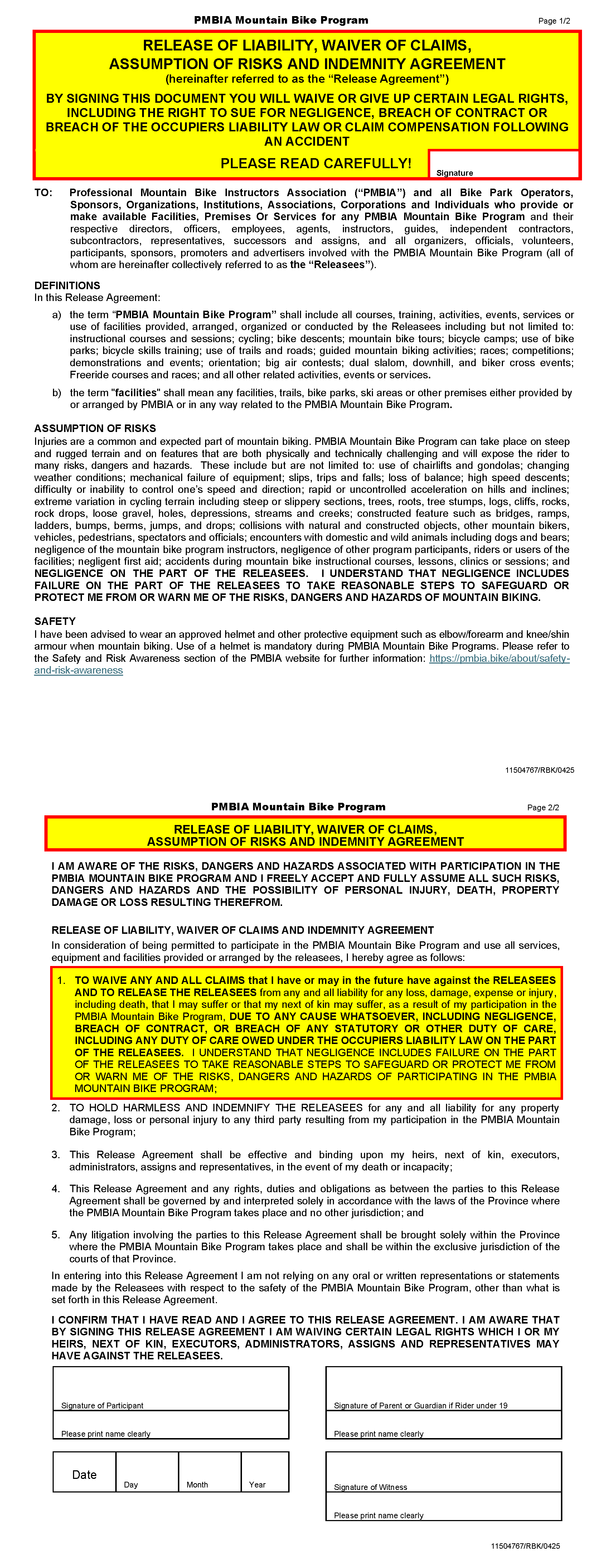
RELEASE OF LIABILITY, WAIVER OF CLAIMS, ASSUMPTION OF RISKS AND INDEMNITY AGREEMENT
All participants in PMBIA Mountain Bike courses are required to sign a Release Agreement when they register for a course, a copy of this release follows:
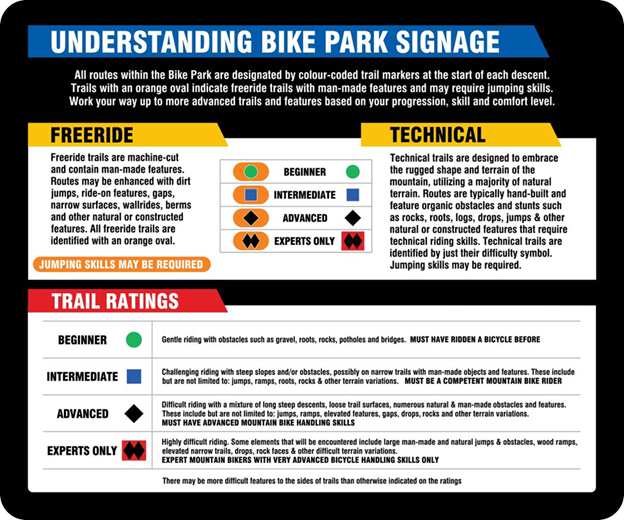
READ AND UNDERSTAND BIKE PARK SIGNS